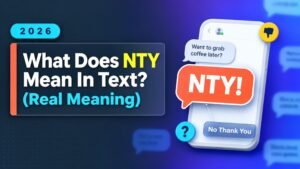
Have you ever received a text message that simply said “NTY” and wondered what the person meant? Internet slang can make everyday conversations confusing, especially when someone uses short abbreviations instead of complete sentences. NTY is a common example of this type of digital language.
In texting, NTY usually means “No Thank You.” People use it to politely decline an offer, invitation, request, or suggestion. Instead of typing a full sentence, they can use three letters to communicate their response quickly.
You may see NTY in text messages, social media comments, gaming chats, and private conversations. Its tone depends on the situation and the relationship between the people communicating. Sometimes it sounds friendly and casual. In other situations, it may seem brief or slightly cold.
Understanding what NTY means can help you interpret messages correctly and avoid unnecessary misunderstandings. This guide explains its real meaning, common uses, practical examples, similar abbreviations, and the best ways to use NTY in 2026.
What Does NTY Mean?
NTY stands for “No Thank You.” It is an abbreviation people use when they want to refuse something without typing a complete response. The expression communicates a negative answer while keeping a basic level of politeness.
For example, imagine that your friend asks, “Do you want to join us for dinner tonight?” You might respond, “NTY, I have other plans.” Your answer means that you appreciate the invitation but do not want to accept it.
NTY is especially common in informal digital communication. People use it because short messages save time and make conversations easier. It is not limited to one particular social media platform or messaging service.
The meaning generally stays the same across different situations. However, the tone can change according to the surrounding words, punctuation, and relationship between the sender and receiver.
Here are the key facts about NTY:
- Full form: No Thank You
- Primary meaning: Politely declining an offer or suggestion
- Tone: Usually casual and polite
- Common platforms: WhatsApp, Snapchat, Instagram, TikTok, Discord, and SMS
- Best use: Informal conversations with friends, family, and online contacts
Although NTY is easy to understand, it does not always explain why someone is refusing. If the reason matters, adding a few words can make the message clearer.
Simple Meaning (In Plain Words)
In plain English, NTY means “No, thank you.” It is a short way to say that you do not want something while acknowledging the other person’s offer.
Think of it as a digital version of a polite refusal. Instead of writing a long response, you can use NTY to communicate your decision quickly.
For example:
- Someone offers you a snack. You reply, “NTY, I’m full.”
- A friend invites you to a party. You say, “NTY, maybe next time.”
- A gamer offers you an item you do not need. You respond, “NTY, I’m good.”
- Someone suggests watching a movie. You write, “NTY, I want to relax tonight.”
In each example, NTY expresses the same basic idea. The additional words explain the reason or make the refusal sound warmer.
The abbreviation does not automatically mean that the sender is angry, upset, or uninterested in the person asking. Most of the time, it simply communicates a preference or decision.
However, replying with only “NTY” can sometimes feel abrupt. If you are speaking to someone who expects a more personal response, adding a friendly phrase can prevent confusion.
Where Is NTY Used?
NTY appears in many types of online communication. Its short format makes it useful when people want to respond quickly without writing a complete sentence.
1. Text Messages and SMS
Traditional text messaging is one place where abbreviations remain useful. People may send NTY when declining invitations, rejecting suggestions, or responding to offers.
For example:
“Want me to pick up coffee for you?”
“NTY, I already have some.”
This response is short, understandable, and appropriate for a casual conversation.
2. WhatsApp and Messenger
Messaging apps support quick conversations between friends, relatives, and coworkers. NTY can help users decline an offer without interrupting the flow of a conversation.
For example:
“Should I order you some food?”
“NTY, I ate already.”
The meaning is clear because the surrounding conversation explains what the sender is refusing.
3. Snapchat and Instagram
Social media users often prefer brief replies in direct messages. NTY can appear when someone declines a meetup, invitation, collaboration, or suggestion.
For example:
“Want to come shopping with us?”
“NTY, I’m staying home today.”
It can also appear in comments when someone responds to an offer or recommendation.
4. TikTok and Other Social Platforms
On TikTok and similar platforms, users may use NTY in comments, direct messages, and informal discussions. It can express disinterest in a suggestion or decline an invitation.
However, slang meanings depend on context. Do not assume every occurrence has the same purpose without reading the surrounding message.
5. Gaming Chats and Discord
Online gamers frequently use abbreviations to communicate quickly during gameplay. NTY may appear when another player offers an item, requests assistance, or suggests a particular strategy.
For example:
“Need this extra weapon?”
“NTY, I have one.”
This short answer communicates the decision without requiring a lengthy conversation.
Why Do People Use NTY?
People use NTY because it makes communication faster and provides a convenient way to decline something. It is particularly useful when a conversation does not require a detailed explanation.
Here are the main reasons people choose this abbreviation.
1. It Saves Time
Typing three letters is quicker than writing a complete sentence. This is useful during fast conversations, gaming sessions, or situations where people are busy.
2. It Keeps Messages Short
Many online conversations rely on brief replies. NTY communicates a complete idea without adding unnecessary details.
3. It Can Sound Polite
The words behind NTY include “thank you.” This helps distinguish it from a plain “no” in situations where the sender wants to acknowledge the offer.
For example, “NTY, but I appreciate it” makes the refusal sound considerate.
4. It Sets Boundaries
People can decline invitations, purchases, requests, and suggestions without agreeing to something they do not want.
A clear refusal is often better than accepting an offer simply to avoid disappointing someone.
5. It Fits Casual Digital Culture
Abbreviations are common in online communication. NTY fits naturally into conversations where people already use expressions such as TY, BTW, and IDK.
Still, using an abbreviation does not guarantee that a message will sound friendly. The surrounding wording and relationship matter just as much.
Real-Life Examples Of NTY In Use
The easiest way to understand NTY is to see how people use it in everyday conversations. The following examples show different situations and tones.
| Situation | Example Conversation | Meaning |
| Declining food | “Want some pizza?” “NTY, I’m full.” | The person does not want food. |
| Rejecting an invitation | “Coming to the party?” “NTY, maybe next time.” | The person declines the invitation. |
| Refusing help | “Need me to help?” “NTY, I’ve got it.” | The person does not need assistance. |
| Online shopping | “Want to buy this?” “NTY, it’s too expensive.” | The person does not want to purchase it. |
| Gaming | “Need extra equipment?” “NTY, I’m ready.” | The player does not need the offer. |
| Casual conversation | “Want to watch a movie?” “NTY, I’m tired.” | The person prefers to rest. |
| Social media | “Want to join our group?” “NTY, thanks.” | The person declines joining. |
| Work discussion | “Would you like another copy?” “NTY, I have one.” | The person already has what they need. |
More Examples With Different Tones
Friendly tone:
“Want to grab lunch?”
“NTY today, but thanks for asking!”
This response declines the invitation while showing appreciation.
Direct tone:
“Do you need another charger?”
“NTY.”
The sender communicates a simple refusal without further explanation.
Casual tone:
“Want to play another round?”
“NTY, I’m logging off.”
The additional words make the reason clear.
Firm tone:
“Do you want to change your decision?”
“NTY. I’ve already decided.”
Here, NTY reinforces a firm boundary. The full sentence makes the sender’s intention clearer.
These examples show that NTY is flexible. It can be friendly, neutral, or firm, depending on the situation.
NTY vs Similar Terms
NTY is not the only abbreviation people use to accept or reject offers. Several other expressions have similar meanings but communicate different levels of politeness or certainty.
| Abbreviation | Full Form | Main Meaning | Difference From NTY |
| NTY | No Thank You | Politely declines | Acknowledges an offer while refusing it |
| TY | Thank You | Expresses gratitude | Does not automatically mean no |
| NP | No Problem | Shows that something is okay | Usually responds to thanks or an apology |
| NVM | Never Mind | Cancels or withdraws a request | Does not necessarily decline an offer |
| IDK | I Don’t Know | Expresses uncertainty | Shows a lack of knowledge rather than refusal |
| No | No | Direct refusal | Can sound more blunt without additional wording |
| TTYL | Talk To You Later | Ends a conversation temporarily | Does not communicate rejection |
| TYSM | Thank You So Much | Expresses strong gratitude | Usually emphasizes appreciation |
NTY vs TY
TY means “Thank You.” It expresses appreciation but does not necessarily reject anything.
NTY means “No Thank You.” It combines appreciation with a refusal.
NTY vs No
“No” is a direct negative response. NTY can sound more polite because it includes thanks.
However, a short NTY may still feel abrupt in a sensitive conversation.
NTY vs NVM
NVM means “Never Mind.” It is commonly used when someone withdraws a request or decides that something is no longer necessary.
NTY is used when a person declines an offer or suggestion.
Choosing the correct abbreviation helps make your intention easier to understand.
When Should You Use NTY?
NTY works best in casual situations where the other person understands texting abbreviations. It is appropriate when you want to decline an offer without writing a lengthy explanation.
You can use NTY when:
- A friend offers you food or a drink.
- Someone invites you to a casual event.
- A gaming partner offers an item you do not need.
- A person suggests an activity you do not want to try.
- Someone asks whether you need additional help.
- You want to politely decline a casual online offer.
For example, “NTY, I already have plans” is a useful response to an invitation. It gives the other person a clear answer and a brief explanation.
When NTY May Not Be Appropriate
Although NTY is common in informal messages, it is not always the best choice.
Avoid relying on it alone in the following situations:
- Professional emails: Write “No, thank you” or a complete sentence.
- Sensitive conversations: Add context to avoid sounding dismissive.
- Important requests: Explain your decision when clarification is necessary.
- Formal customer communication: Use professional language.
- Conversations with unfamiliar people: A full phrase may sound more courteous.
For example, instead of replying “NTY” to a manager’s offer of support, you could write, “No, thank you. I have everything I need at the moment.”
The main rule is simple: match your language to the situation. Informal abbreviations are useful, but clear communication should always come first.
Common Misunderstandings About NTY
Even though NTY has a straightforward meaning, people sometimes interpret it incorrectly. Understanding these common mistakes can help you avoid confusion.
1. Thinking NTY Means Anger
NTY does not automatically indicate anger or frustration. Most people use it as a quick refusal.
A person might simply be busy, tired, full, or uninterested in a particular activity.
2. Confusing NTY With TY
The difference is important. TY means “Thank You,” while NTY means “No Thank You.”
One expresses gratitude. The other expresses gratitude while declining an offer.
3. Assuming It Is Always Rude
NTY can be polite, especially when the context is casual. However, a one-word reply may seem cold to someone expecting a warmer response.
Adding “thanks” or a short explanation can improve the tone.
4. Believing It Always Ends a Conversation
NTY does not necessarily mean that someone wants to stop talking. The person may be declining one specific offer while remaining interested in the conversation.
For example, “NTY to coffee, but I’d love to go for a walk” shows that the person is rejecting one activity, not the company.
5. Assuming It Has the Same Tone Everywhere
Communication styles vary across people, communities, and platforms. Some people use abbreviations frequently, while others prefer complete sentences.
Always consider the conversation before deciding what the sender intended.
Pro Tips For Using NTY The Right Way
Using NTY effectively is about more than knowing its full form. You should also consider your audience, the context, and the impression your message may create.
Follow these practical tips to communicate more clearly.
- Add a thank-you when appropriate. Writing “NTY, thanks!” can make your refusal sound more considerate.
- Explain your reason when necessary. A short phrase such as “I’m busy today” helps the other person understand your decision.
- Consider your relationship. Close friends may understand a brief response, while professional contacts may expect more detail.
- Avoid unnecessary explanations. You can decline an offer without sharing private information.
- Use complete sentences in formal situations. Professional communication generally benefits from clear, standard wording.
- Read the conversation before interpreting a reply. A short NTY does not automatically indicate a negative attitude toward you.
- Respect other people’s boundaries. If someone responds with NTY, accept the refusal rather than repeatedly asking.
- Do not overuse abbreviations. Clear language is more helpful when the other person may not understand internet slang.
Remember that politeness does not require accepting every invitation or offer. You can say no while still respecting another person’s feelings.
A simple response such as “No, thank you, but I appreciate it” is often enough. In casual chats, NTY can communicate the same idea with fewer characters.
Final Thoughts
NTY means “No Thank You” in texting and online conversations. People use it to decline offers, invitations, suggestions, and requests without typing a complete sentence. It is common in messaging apps, social media, gaming chats, and everyday digital communication. The abbreviation is usually neutral or polite, but its tone depends on context.
If you receive NTY in a message, do not immediately assume that the sender is angry or upset. They may simply be declining a specific offer. If you want to use NTY yourself, consider adding a few friendly words when the situation calls for them. Understanding this simple abbreviation can make your online conversations clearer, more natural, and less likely to cause misunderstandings.
FAQ Section
1. What does NTY mean in text messages?
NTY means “No Thank You.” It is a short way to politely decline an offer, invitation, or suggestion.
2. What does NTY mean on Snapchat?
On Snapchat, NTY usually means “No Thank You.” People use it in chats and replies when they want to refuse something casually.
3. Is NTY rude when texting someone?
Not necessarily. NTY is usually a neutral or polite refusal, but it may sound abrupt without additional words or context.
4. What does NTY mean on Instagram or TikTok?
On Instagram and TikTok, NTY generally means “No Thank You.” It can appear in direct messages, comments, or casual conversations.
5. What is the difference between NTY and TY?
NTY means “No Thank You,” while TY means “Thank You.” NTY communicates a refusal, whereas TY expresses gratitude.
6. How should I reply when someone sends NTY?
You can accept the refusal with a response such as “No problem,” “Okay, no worries,” or “All good.” Avoid pressuring the person to change their mind.
7. Can I use NTY in professional messages?
You can, but it is usually better to write “No, thank you” in professional emails and workplace conversations. Complete wording sounds clearer and more formal.